
Cooling Tower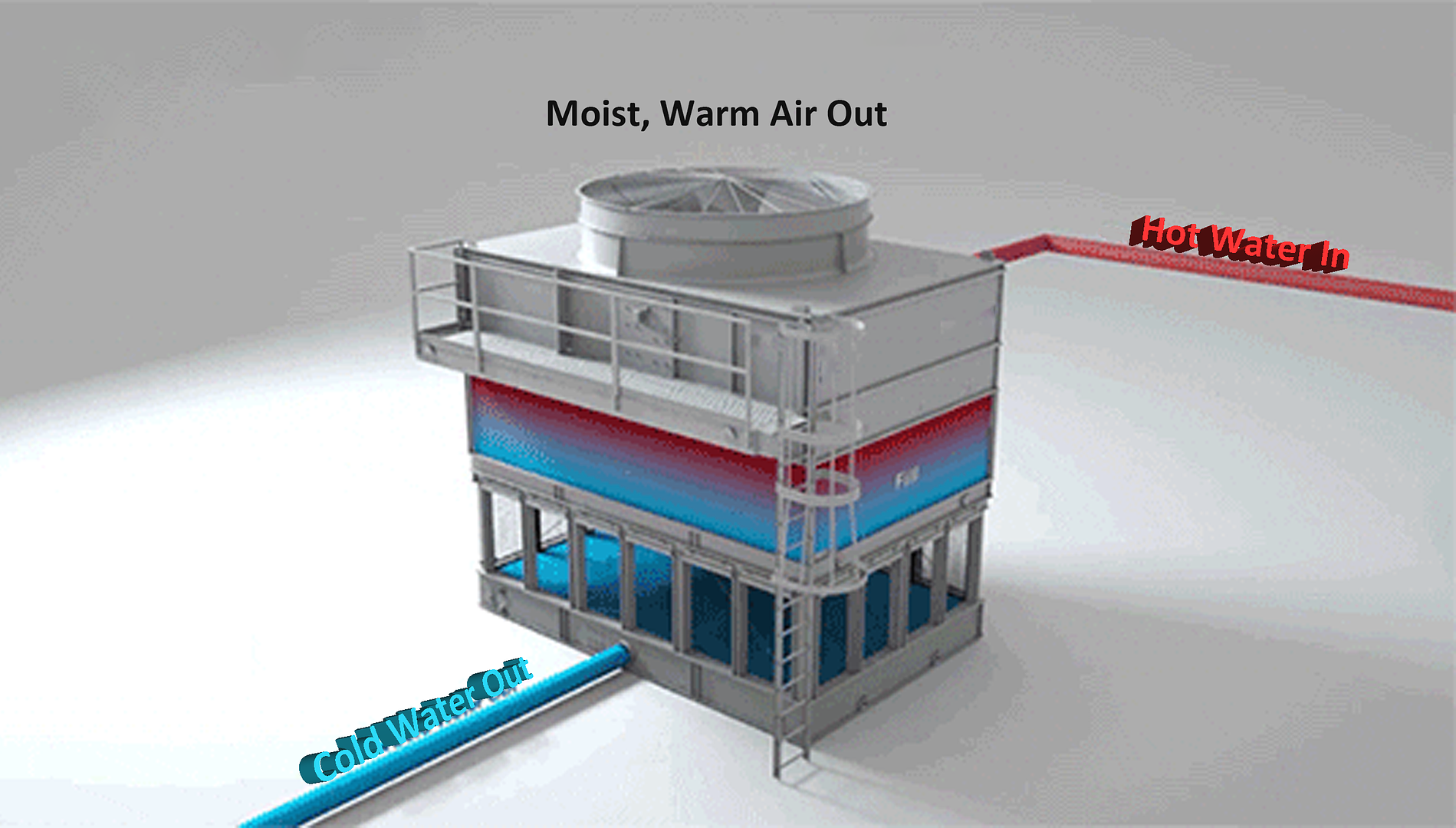
Air-Cooled vs. Water-Cooled Water Chillers in HVAC: What’s the Difference?
In commercial HVAC systems, water chillers are a cornerstone of comfort cooling and process cooling. They remove heat from a chilled-water loop and reject that heat elsewhere, enabling consistent temperature control across office buildings, hospitals, data centers, manufacturing plants, and more. A common question when planning, upgrading, or maintaining a chilled-water plant is: What is the difference between an air-cooled water chiller and a water-cooled water chiller?
While both types produce chilled water, the key difference is how they reject heat. That single design choice impacts installation requirements, energy efficiency, maintenance needs, operating costs, and ideal applications.
What Both Chillers Have in Common
Both air-cooled and water-cooled water chillers perform the same basic job: they cool water (or a water/glycol mix) by using a refrigeration cycle. The chilled water is then pumped to air handlers, fan coils, or process equipment to absorb heat from the building or process.
The major distinction is where the heat goes after the chiller removes it from the chilled-water loop.
Air-Cooled Water Chiller: Heat Rejection to Outdoor Air
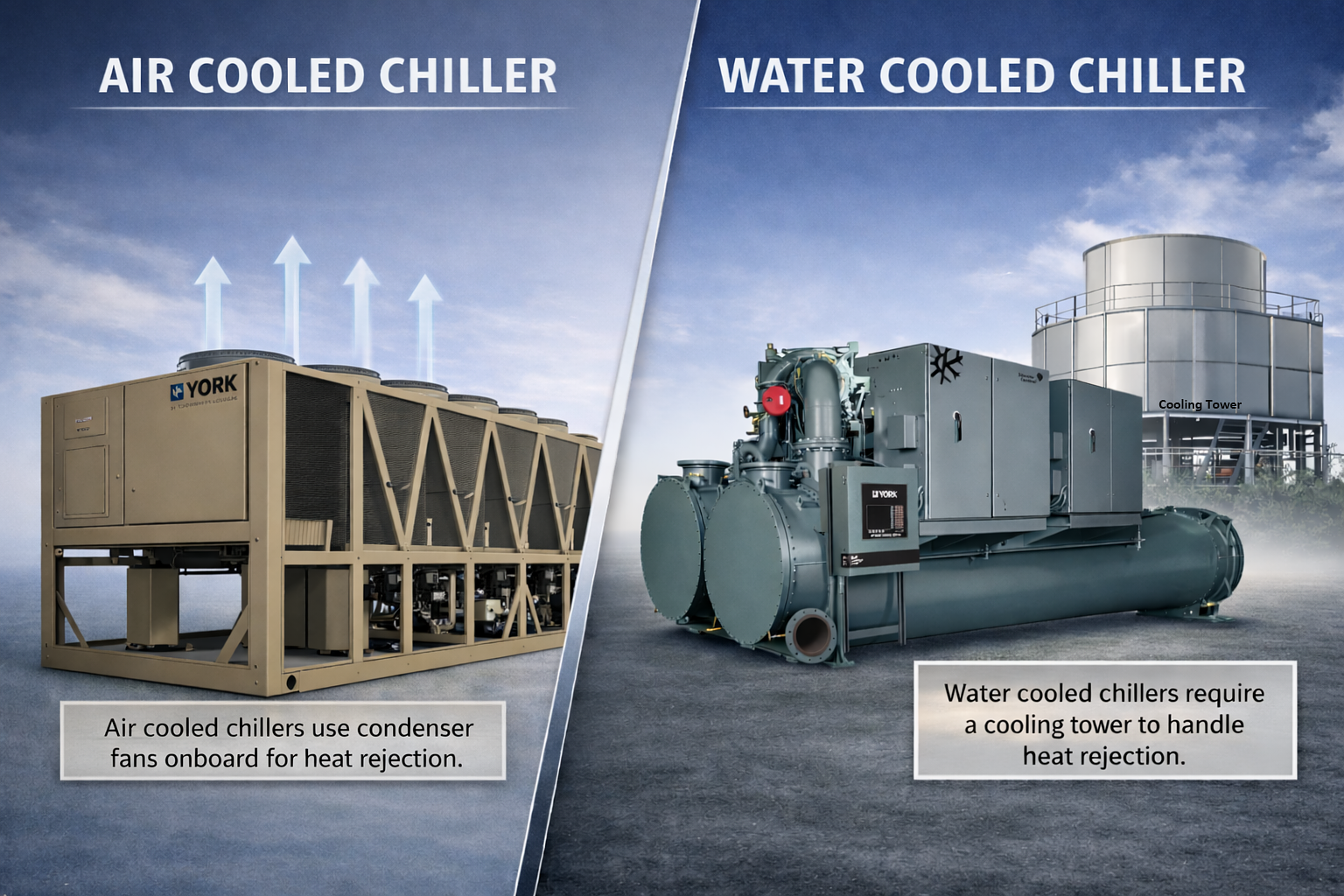
An air-cooled water chiller rejects heat directly to the surrounding air. It uses outdoor condenser coils and fans—similar in principle to a large rooftop unit or condensing unit. As the refrigerant releases heat in the condenser coil, fans move ambient air across the coil to carry the heat away.
Key Components
- Condenser coil (typically fin-and-tube or microchannel)
- Condenser fans to move air across the coil
- Compressor(s), evaporator, expansion device (standard refrigeration components)
Typical Installation
Air-cooled chillers are commonly installed outdoors on a roof, pad, or adjacent equipment yard. They do not require a cooling tower, condenser water piping, or extensive water treatment programs.
Water-Cooled Water Chiller: Heat Rejection to Water (Usually via Cooling Tower)
A water-cooled water chiller rejects heat to a separate condenser water loop. Instead of using fans and outdoor air to remove heat, the chiller transfers heat into condenser water through a condenser heat exchanger. That warm condenser water typically flows to a cooling tower, where the heat is rejected to the atmosphere through evaporation and airflow.
Key Components
- Condenser heat exchanger (often shell-and-tube)
- Cooling tower (or other heat rejection device such as a fluid cooler in some designs)
- Condenser water pumps and piping
- Water treatment and filtration equipment (commonly required)
Typical Installation
Water-cooled chillers are usually housed in a mechanical room, with cooling towers installed on the roof or outdoors. They require additional infrastructure—pumps, tower, piping, controls, and ongoing water management.
Side-by-Side Differences That Matter in Real Projects
1) Efficiency and Operating Cost
Water-cooled chillers are often more energy-efficient, especially at larger capacities and in buildings with long operating hours. Cooling towers can reject heat more effectively than air-cooled condensers, particularly during hot weather, because evaporative cooling can achieve lower leaving water temperatures than ambient air alone.
Air-cooled chillers tend to be less efficient at peak conditions in hot climates since they must reject heat to already-warm outdoor air. However, modern air-cooled designs with variable-speed fans, high-efficiency compressors, and optimized heat exchangers have narrowed the gap in many applications.
Practical takeaway: For large, continuously operated facilities, water-cooled systems often win on lifecycle energy cost. For smaller or intermittent loads, air-cooled can be highly competitive.
2) First Cost and System Complexity
Air-cooled chillers typically have lower first cost and simpler installation. They are more “packaged,” with fewer field-installed components. There’s no cooling tower, no condenser water pumps, and usually less piping and control complexity.
Water-cooled chillers generally have higher upfront cost because you are buying and installing a complete heat rejection system (tower, pumps, piping, valves, controls) and accommodating space in the mechanical room.
Practical takeaway: If budget, speed of installation, or mechanical room space is tight, air-cooled often has an advantage.
3) Maintenance Requirements
Air-cooled chiller maintenance focuses heavily on keeping condenser coils clean and ensuring fans and motors are operating correctly. Dirty coils can significantly reduce capacity and efficiency, especially in dusty or industrial environments.
Water-cooled chiller maintenance is more involved due to the condenser water loop and cooling tower. This includes:
- Water treatment to manage scale, corrosion, and biological growth
- Cooling tower cleaning and inspections
- Condenser tube cleaning to maintain heat transfer
- Legionella risk management and compliance with relevant guidelines and local requirements
Practical takeaway: Water-cooled systems can deliver excellent performance but demand disciplined maintenance and water management.
4) Water Use and Sustainability Considerations
Air-cooled chillers use little to no water during normal operation, making them attractive in regions with water scarcity or high water costs.
Water-cooled chillers paired with cooling towers typically consume water through evaporation and blowdown, and may also require chemical treatment. In some sustainability frameworks, the energy savings may offset the water use, but it depends on local utility costs and environmental priorities.
Practical takeaway: If water conservation is a primary goal, air-cooled chillers are often preferred.
5) Footprint, Noise, and Site Constraints
Air-cooled chillers are outdoors and can be noisier due to multiple condenser fans, which may require acoustic considerations near occupied areas or property lines. They also require adequate clearance for airflow and service access.
Water-cooled chillers are typically indoors and can be quieter at the chiller itself, but the cooling tower introduces its own noise profile and requires roof or yard space. Tower placement and plume management can also be design considerations.
Practical takeaway: Site layout, roof capacity, and noise ordinances can be deciding factors.
When to Choose Air-Cooled vs. Water-Cooled
Air-Cooled Water Chillers Are Often a Good Fit For:
- Small to mid-sized buildings or systems
- Projects needing lower first cost and faster installation
- Facilities with limited mechanical room space
- Regions with high water costs or water restrictions
- Owners who want simpler maintenance and fewer auxiliary systems
Water-Cooled Water Chillers Are Often a Good Fit For:
- Large buildings, campuses, and district cooling applications
- Facilities with high annual run hours (hospitals, data centers, industrial plants)
- Projects targeting maximum energy efficiency and lower long-term operating costs
- Sites that can support a cooling tower and water treatment program
- Owners with in-house maintenance capabilities or a strong service partner
Bottom Line: The Core Difference in One Sentence
The difference between an air-cooled water chiller and a water-cooled water chiller is the method of heat rejection: air-cooled units reject heat to outdoor air using condenser fans and coils, while water-cooled units reject heat to a condenser water loop—typically through a cooling tower—often delivering higher efficiency at the cost of greater system complexity.
Next Step: Choosing the Right Chiller for Your Facility
The best choice depends on your building size, climate, operating hours, water availability, maintenance resources, and energy goals. If you share your approximate cooling load (tons or kW), location/climate, and whether you have an existing cooling tower, it’s possible to narrow down the most cost-effective chiller type and configuration for your specific HVAC application.