
Scroll Compressors Chillers versus Dual Variable VFD Scew Compressor Chillers
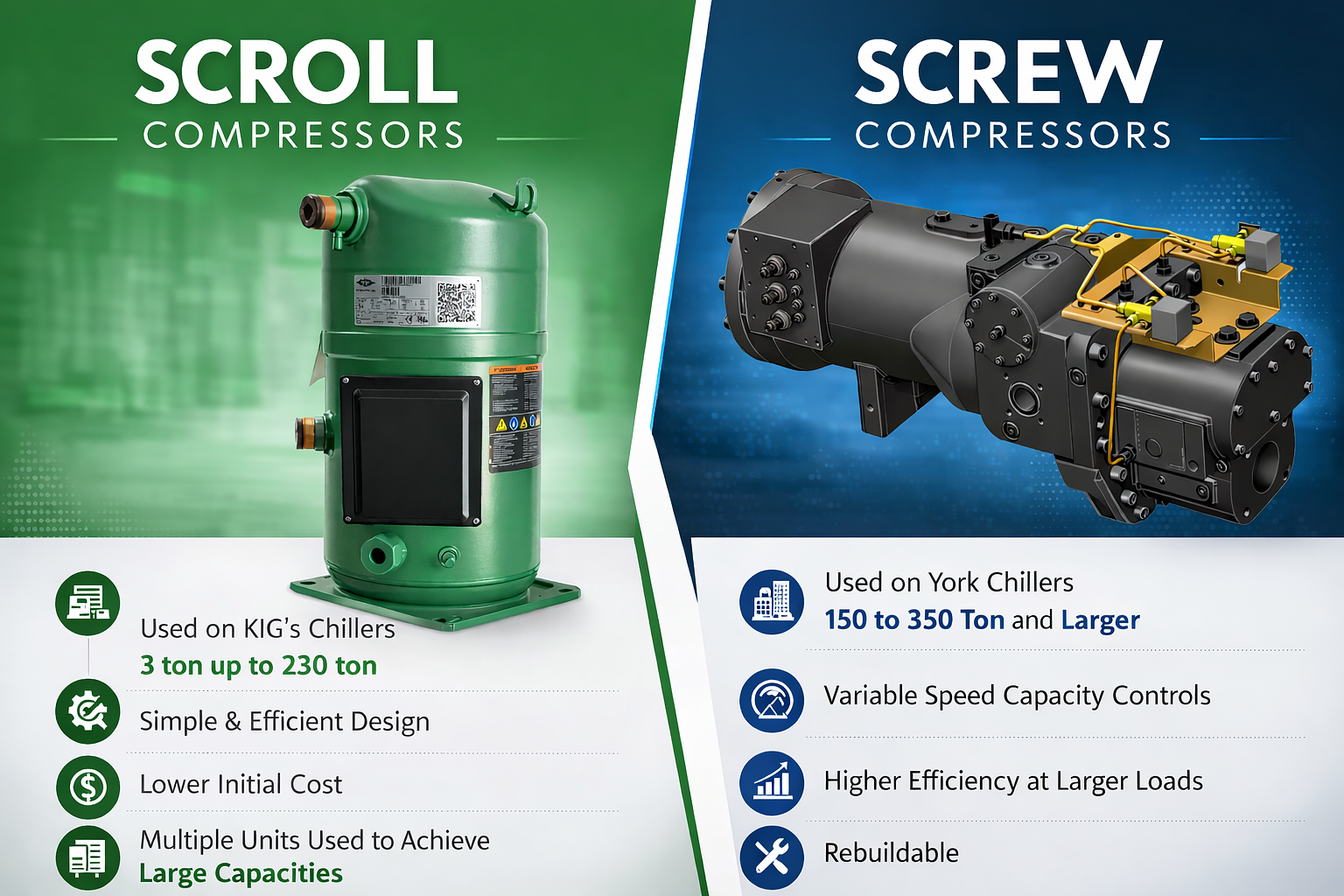
Scroll vs. Dual Variable VFD Screw Compressors: Key Differences
In the industrial chiller market, compressor selection is one of the most consequential design decisions for energy performance, capacity control, uptime, and life-cycle cost. Within the YORK / Johnson Controls chiller ecosystem, two common compressor approaches are scroll compressors (often used in modular and mid-tonnage chillers) and dual variable VFD screw compressors (typically used for higher capacity and high-efficiency applications). While both can deliver reliable cooling, they differ significantly in how they compress refrigerant, how they control capacity, and how they behave across real-world operating conditions.
This guide outlines the main differences between scroll and dual variable VFD screw compressors for chillers, plus practical pros and cons of each—framed for industrial HVAC decision-makers who care about efficiency, controllability, maintainability, and total cost of ownership.
How Each Compressor Type Works (In Plain Terms)
Scroll Compressors in Chillers
A scroll compressor uses two spiral-shaped scroll elements: one fixed and one orbiting. As the orbiting scroll moves, refrigerant is trapped and compressed toward the center. In chiller applications, scroll compressors are frequently arranged in multiple-compressor “banks” or modules so capacity can be staged (turning compressors on/off) to match load.
Dual Variable VFD Screw Compressors in Chillers
A screw compressor uses two intermeshing rotors to compress refrigerant along the rotor length. In a dual variable VFD screw arrangement, capacity is controlled through variable-speed drives (VFDs) and, depending on the specific design, additional unloading/slide mechanisms or independent compressor circuits. The “dual variable” concept generally points to high turndown and refined part-load control, often via multiple compressors, multiple circuits, or advanced control strategies.
Main Differences Between Scroll and Dual Variable VFD Screw Chillers
1) Capacity Range and Typical Applications
Scroll chillers are commonly used in small-to-mid tonnage applications where modularity and redundancy are priorities—think light industrial facilities, commercial plants, process support loads, and distributed cooling.
Dual variable VFD screw chillers are more common in larger tonnage and more demanding industrial settings where high efficiency at varying loads, strong lift capability, and stable leaving water temperature control are essential—such as manufacturing, data centers, district energy, and critical process cooling.
2) Part-Load Efficiency and Load Matching
Scroll systems often achieve part-load performance by staging: turning compressors on/off in steps. This can be effective, especially with many compressors providing small increments, but it is not as “smooth” as true variable-speed modulation.
VFD screw systems can modulate continuously over a wide operating range, which typically improves seasonal efficiency (kW/ton) and helps maintain tighter temperature control under fluctuating loads.
3) Turndown and Temperature Control Stability
Scroll chillers with multiple compressors can offer good turndown and redundancy, but they may still introduce more frequent cycling at low loads depending on system design, minimum compressor on-time logic, and water volume.
Dual variable VFD screw chillers generally provide excellent low-load stability with less cycling, which is valuable when the plant runs at partial load for long periods (a common reality in most facilities).
4) Maintenance Profile and Service Complexity
Scroll compressors are mechanically simpler and often easier to replace in the field. However, systems with many scroll compressors can increase the number of components—contactors, crankcase heaters, sensors, solenoids, and oil management elements (if applicable).
VFD screw compressors are more complex machines with VFD electronics and screw compressor service considerations. Service typically requires more specialized expertise, but the system may have fewer compressors overall.
5) Redundancy and Risk Distribution
Scroll-based chillers frequently provide inherent redundancy: if one compressor fails, the chiller can often continue operating at reduced capacity.
With larger screw compressors, redundancy depends on the number of compressors/circuits. A dual compressor or dual circuit VFD screw design can still provide strong resilience, but in some configurations, a single compressor represents a larger share of plant capacity.
Pros and Cons of Scroll Compressors for Chillers
Advantages
- Mechanical simplicity: Fewer moving parts and a proven compression method that is widely supported by service networks.
- Modularity and redundancy: Multiple scroll compressors can maintain partial operation if a compressor is offline.
- Lower first cost in many cases: Particularly attractive for smaller industrial loads or distributed cooling strategies.
- Good efficiency in the right range: When properly sized and staged, scroll chillers can perform well for steady or moderately varying loads.
Trade-Offs
- Stepwise capacity control: Staging can be less precise than VFD modulation, potentially leading to more cycling at low loads.
- More components overall: Multiple compressors mean more electrical and control components to monitor and maintain.
- Performance limits at higher tonnage/lift: For very large capacities or demanding conditions, screw technology often scales more efficiently.
- Potential acoustic considerations: Many smaller compressors can create a different noise profile than fewer larger compressors, depending on enclosure and installation.
Pros and Cons of Dual Variable VFD Screw Compressors for Chillers
Advantages
- Superior part-load performance: VFD control can significantly reduce energy use during the many hours a chiller operates below full load.
- Smooth, wide-range modulation: Better control of leaving chilled water temperature and reduced cycling stress.
- Strong fit for industrial duty: Screw compressors are widely used in heavy-duty and continuous-operation environments.
- Potentially fewer compressors to manage: Simplifies some maintenance and monitoring tasks compared to multi-scroll banks.
Trade-Offs
- Higher upfront cost: VFDs and screw compressor platforms typically increase initial investment.
- More specialized service requirements: Diagnostics and repairs may require technicians experienced with VFDs, controls, and screw compressor service procedures.
- Electronics sensitivity: VFDs can be sensitive to power quality issues; proper grounding, filtering, and electrical design matter.
- Redundancy depends on architecture: A dual-compressor/dual-circuit design can be robust, but a single large compressor configuration concentrates risk.
Which Is Better for YORK / Johnson Controls Industrial Chiller Projects?
The “better” choice depends on operating profile and business priorities:
Choose scroll compressor chillers when you want cost-effective capacity in small-to-mid tonnage ranges, you value modular redundancy, and your load profile does not demand ultra-tight control at very low loads. Scroll-based systems can also be attractive where maintenance teams prefer simpler compressor replacements and facilities benefit from distributed cooling.
Choose dual variable VFD screw compressor chillers when your facility runs many hours at part load, energy cost is a dominant concern, and stable leaving water temperature matters for production quality or process control. VFD screw chillers are often well-suited for large industrial plants, central utility systems, and high-runtime applications where seasonal efficiency improvements translate into meaningful operating savings.
Selection Checklist: Questions to Ask Before You Specify
Before committing to a compressor type, evaluate these practical factors:
- Load profile: How many hours per year are at 40–80% load versus near full load?
- Required turndown: What is the lowest stable load without excessive cycling?
- Temperature stability needs: How tight must leaving chilled water temperature control be for your process?
- Redundancy requirements: Can the plant tolerate reduced tonnage if one compressor or circuit is down?
- Electrical environment: Is power quality suitable for VFDs (harmonics, grounding, transients)?
- Service strategy: In-house maintenance capability vs. reliance on factory-authorized service providers.
Bottom Line
In the HVAC industrial chiller industry, scroll compressors generally win on simplicity, modular redundancy, and cost-effective mid-range capacity, while dual variable VFD screw compressors often lead in part-load efficiency, smooth modulation, and performance in larger, more demanding applications. For YORK / Johnson Controls chiller buyers, aligning compressor technology with load profile, redundancy needs, and service capabilities is the most reliable way to maximize uptime and minimize life-cycle cost.