
Brazed Plate Evaporator (BPE) versus Shell & Tube (S&T)
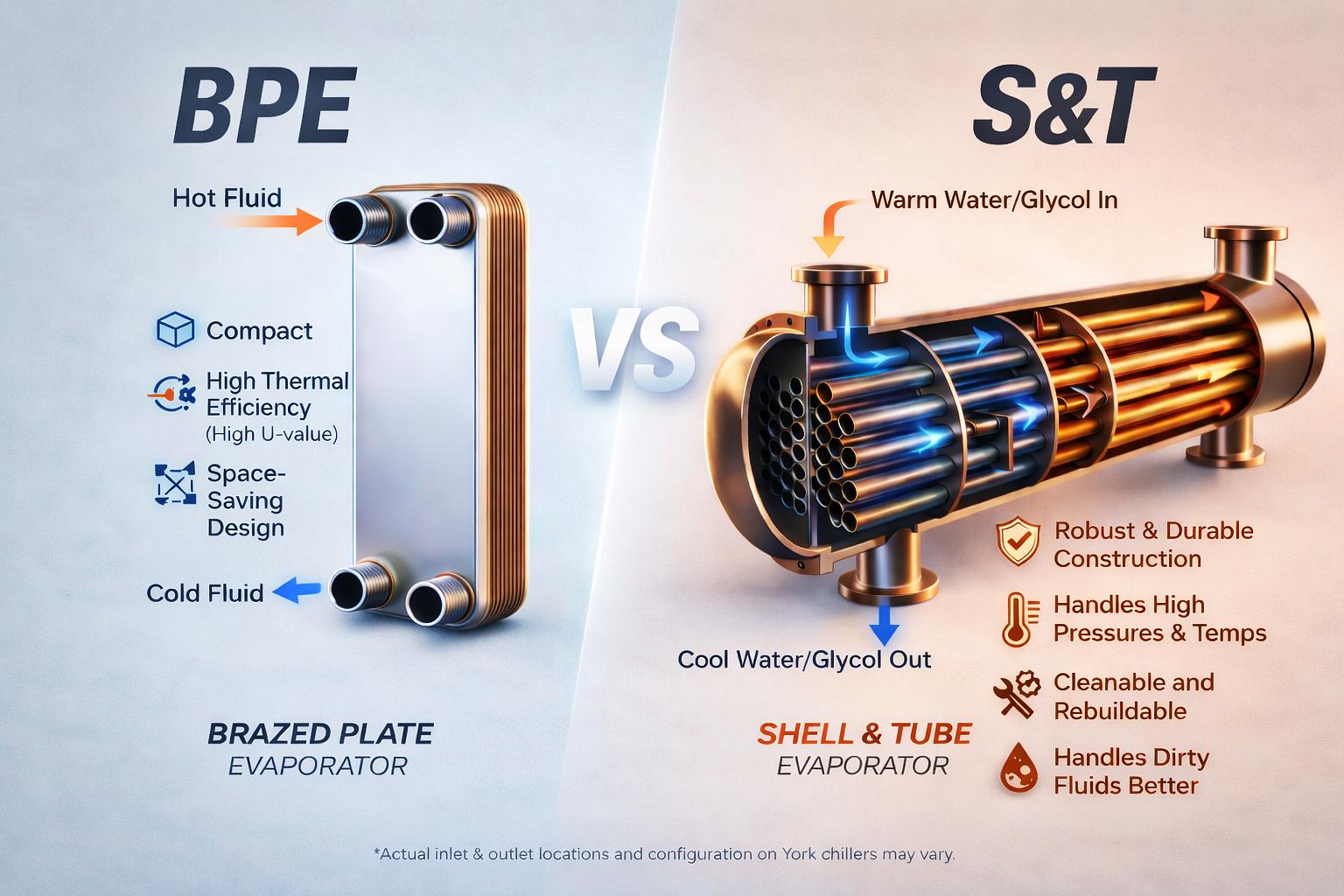
Brazed Plate vs. Shell-and-Tube Evaporators in Industrial HVAC Chillers: Key Differences and How to Choose
In industrial HVAC chillers, the evaporator is where heat is absorbed from the chilled water (or glycol) loop into the refrigerant. The evaporator type you choose directly affects efficiency, footprint, maintenance requirements, water-side pressure drop, and long-term reliability. Two common designs dominate industrial and commercial chiller applications: the brazed plate evaporator (BPE) and the shell-and-tube evaporator (S&T).
Below is a practical comparison to help facility managers, plant engineers, and chiller specifiers select the right evaporator for their operating conditions.
How Each Evaporator Works (In Plain Terms)
Brazed Plate Evaporator (BPE)
A brazed plate heat exchanger is built from thin, corrugated stainless-steel plates stacked together and brazed (commonly with copper) into a sealed block. Refrigerant and water flow through alternating channels. The corrugations create turbulence, which drives high heat transfer in a compact package.
Shell-and-Tube Evaporator (S&T)
A shell-and-tube evaporator uses a bundle of tubes inside a cylindrical shell. One fluid flows inside the tubes, the other flows around them in the shell. In many chiller designs, chilled water flows through the tubes while refrigerant boils on the shell side (though configurations vary).
Core Differences That Matter in Industrial Chiller Applications
1) Heat Transfer Efficiency and Approach Temperature
Brazed plate evaporators typically deliver very high heat transfer coefficients due to thin plates and turbulent flow. This often translates into excellent performance at lower approach temperatures (the difference between leaving chilled water temperature and refrigerant saturation temperature), helping improve overall chiller efficiency.
Shell-and-tube evaporators can also be highly efficient, but efficiency depends more on tube design, baffle arrangement, fouling factor, and flow regime. In many industrial scenarios, the performance gap narrows when S&T units are properly sized and optimized.
Best fit: If you need compact, high-efficiency heat transfer and stable, clean water conditions, a brazed plate evaporator is often advantageous.
2) Footprint, Weight, and Refrigerant Charge
Brazed plate evaporators are compact and lightweight, making them attractive where mechanical room space is limited or skid-mounted chillers are preferred. They also typically require less refrigerant charge than comparable shell-and-tube designs—an increasingly important factor for cost, safety, and regulatory compliance.
Shell-and-tube evaporators are larger and heavier, but their physical robustness and serviceability are often valued in heavy-duty industrial service.
3) Water-Side Pressure Drop and Pumping Energy
Because brazed plate heat exchangers use narrow flow channels to create turbulence, they often come with higher water-side pressure drop than shell-and-tube designs for the same duty. Higher pressure drop can increase pumping energy and may require larger pumps.
Shell-and-tube evaporators, with larger tube diameters and more design flexibility, can be selected to achieve lower pressure drop—a meaningful advantage in large flow systems or where pumping energy is a major operating cost.
4) Fouling Tolerance and Water Quality Requirements
Industrial chilled water loops can contain debris, scale, corrosion products, or biological growth—especially in older buildings, process plants, or systems with imperfect treatment.
- Brazed plate evaporators are less tolerant of fouling and particulates. Narrow passages can plug, and scaling can quickly reduce performance. They generally require good filtration and reliable water treatment.
- Shell-and-tube evaporators are typically more forgiving, especially with larger tube passages and the ability to select tube materials and velocities to manage fouling risk.
Rule of thumb: If you have variable water quality, higher fouling potential, or limited confidence in ongoing water treatment, shell-and-tube is often the safer choice.
5) Maintenance, Cleaning, and Serviceability
This is one of the biggest operational differences.
Brazed plate evaporators are not mechanically cleanable in the same way as many shell-and-tube designs because the plates are permanently brazed together. Cleaning is typically done using chemical cleaning (CIP) and flushing. If plugging or severe fouling occurs, replacement may be the fastest path.
Shell-and-tube evaporators can be opened and mechanically cleaned (brushing, hydro-jetting) depending on head design. Tubes can sometimes be inspected, plugged, or replaced. For facilities with on-site maintenance teams and a preventive maintenance program, this serviceability can reduce lifecycle risk.
6) Freeze Risk and Low-Temperature Applications (Water/Glycol)
Evaporators in chiller systems can be exposed to freeze risk during low load, low flow, improper control sequences, or power events. Plate evaporators often have less internal volume and thinner heat transfer surfaces, which can be beneficial for responsiveness but can be less forgiving if flow is interrupted.
Shell-and-tube designs tend to have more thermal mass and volume, and many can be configured with freeze-protection strategies (flow arrangements, controls, and selection choices) that suit harsh environments. For glycol chillers and low leaving fluid temperatures, both designs can work well, but the selection should consider controls, minimum flow, and safety interlocks.
7) Pressure Ratings and Mechanical Robustness
Both evaporator types can be engineered for industrial pressure requirements, but shell-and-tube is often favored for ruggedness in demanding duty cycles, large tonnage, and systems with frequent transients. Brazed plate units are robust in their own right, but they are more sensitive to certain failure modes such as channel blockage, water hammer, or improper installation practices (for example, inadequate strainers/filters).
8) Cost Considerations (Upfront vs. Lifecycle)
Brazed plate evaporators often have a lower upfront cost for smaller and mid-size chillers and can reduce costs tied to footprint and refrigerant charge.
Shell-and-tube evaporators may cost more initially, but they can offer lifecycle value through maintainability, longer service life in fouling conditions, and reduced downtime risk—particularly in industrial facilities where uptime is critical.
Common Use Cases: Which Evaporator Fits Best?
Brazed Plate Evaporator: Often Preferred When
- You need a compact chiller package (skid systems, tight mechanical rooms).
- Water quality is clean and well-controlled with proper filtration.
- You want high heat transfer performance and potentially lower approach temperatures.
- Lower refrigerant charge is a priority.
Shell-and-Tube Evaporator: Often Preferred When
- The system has higher fouling risk or variable water quality.
- You require mechanical cleaning and field serviceability.
- You want lower water-side pressure drop for large flows.
- The application is large tonnage, mission-critical, or industrial process cooling.
Selection Checklist for Industrial HVAC Chillers
To choose confidently, evaluate these factors early in design:
- Water quality and treatment program: filtration level, scaling tendency, corrosion control, biological control.
- Allowable pressure drop: pump sizing, energy cost, system hydraulics.
- Maintenance strategy: in-house capability, shutdown windows, tolerance for replacement vs. repair.
- Operating temperatures: leaving fluid temperature, glycol concentration, freeze protection requirements.
- Space and weight constraints: retrofit vs. new build, rooftop/skid limitations.
- Risk profile: downtime cost, redundancy, criticality of chilled water to production.
Bottom Line
The difference between a brazed plate evaporator and a shell-and-tube evaporator is not simply “modern vs. traditional.” It is a trade-off between compact, high-performance heat transfer (brazed plate) and robust, serviceable, fouling-tolerant operation (shell-and-tube). For clean, well-controlled loops and space-sensitive installations, brazed plate evaporators can be an excellent fit. For industrial environments with uncertain water quality, high uptime requirements, and a maintenance-first mindset, shell-and-tube evaporators often provide greater long-term resilience.
If you share your chiller tonnage, leaving chilled water temperature, fluid type (water or glycol), and water quality conditions, it is possible to narrow the choice and identify the critical sizing and maintenance considerations for your specific facility.